

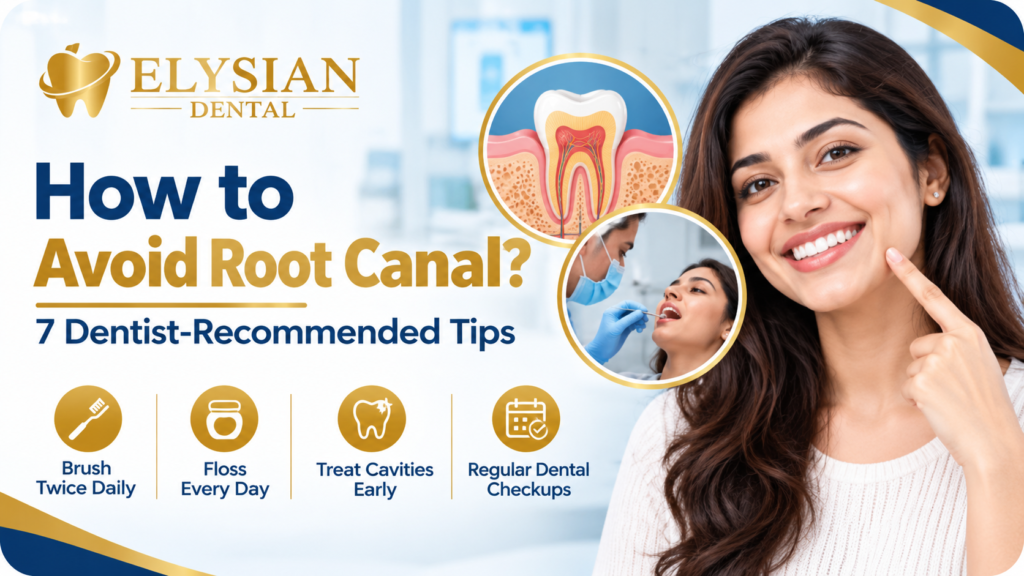
Avoid root canal treatment by practicing appropriate dental hygiene. One must brush one’s teeth twice a day, floss regularly, fill in any cavities as soon as possible, and visit the dentist. In doing so, one is assured that the decaying process will not advance to the point where root canal treatment will be required.
Pain, sensitivity, and small cavities cannot be ignored. Proper care can save your natural teeth from root canal treatment.
Here are 7 ways recommended by dentists to avoid root canal treatment and dental decay.
7 Practical Ways to Avoid Root Canal Treatment
These simple practices can help one avoid root canal treatment.
| Dental habit | What you should do |
| Brush twice daily | Brush morning and night for a full two minutes, using fluoride toothpaste. |
| Clean between teeth | Floss or use a small interdental brush once a day. Your brush can’t reach those gaps. |
| Reduce sugar | Cut back on sweets, sugary drinks and constant snacking. |
| Drink water | Keep a bottle of water handy instead of sipping sweet drinks for hours. |
| Treat cavities early | Don’t wait. Get a cavity filled before it reaches the pulp. |
| Protect your teeth | Wear a mouthguard when you play contact sports, and quit chewing ice. |
| Get regular check-ups | Visit your dentist even when your teeth feel fine. |
Most cavities start with plaque, and these habits help you avoid root canal treatment by keeping it from building up.
Why Is a Root Canal Needed and How to Avoid Root Canal Treatment
Each tooth has a soft interior referred to as the pulp. Nerves and blood vessels live there. A deep cavity, a crack, a tooth that’s been drilled again and again, or a hard hit can all damage it, so taking care of these problems early is the best way to avoid root canal treatment.
Once that pulp is infected or badly inflamed, a regular filling usually won’t cut it, and it becomes very hard to avoid root canal treatment.
Common warning signs
- A toothache that keeps coming back
- Pain when you bite down or chew
- Hot or cold sensitivity that hangs around
- Swollen gums
- A small pimple-like bump near the sore tooth
- A cracked, chipped or darkened tooth
Having one of these doesn’t mean a root canal is a sure thing. Your dentist will look at the tooth, and an X-ray usually shows what’s really going on.
Go early and the fix may be a lot simpler. Some of the time, you can even avoid root canal treatment altogether.
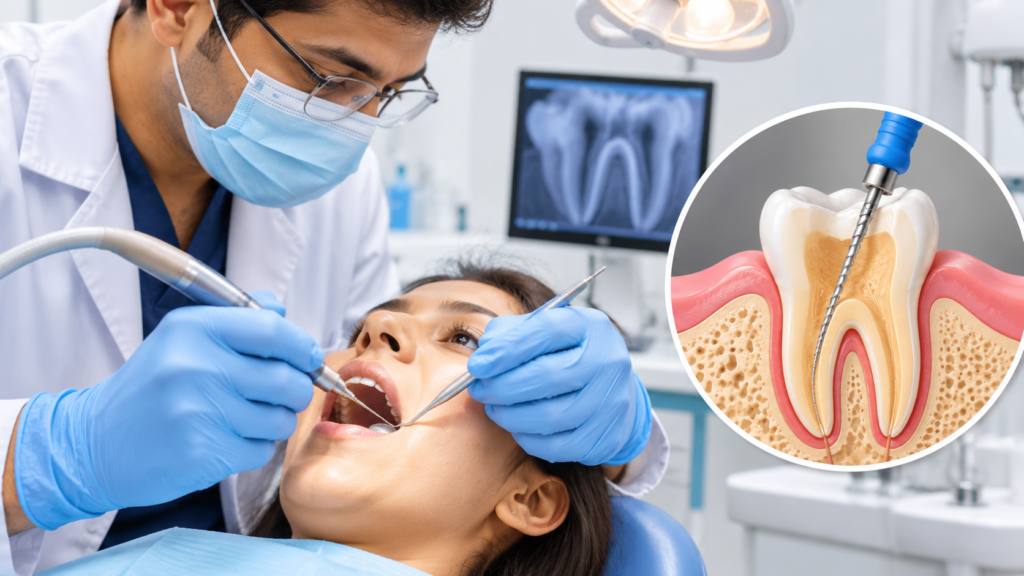
How Does Root Canal Therapy Work?
The dentist will remove the infected or injured pulp from your tooth, clean the area, and seal it up. And that’s about it. The idea is to save your natural tooth.
Steps involved in treatment
- Dental examination: The dentist asks about your pain and checks the tooth.
- X-ray: The scan shows the roots and how far the trouble has gone.
- Local anaesthesia: The area is numbed, so you shouldn’t feel much.
- Pulp removal: The damaged tissue comes out from inside the tooth.
- Cleaning and sealing: The canals are cleaned, shaped and sealed shut.
- Final restoration: A filling or crown goes on to protect the tooth.
How long does root canal treatment take?
That depends on which tooth it is, how bad the infection is and how tricky the canals are.
| Treatment | Approximate duration |
| Single-sitting root canal | Often around 30–90 minutes |
| Multi-visit root canal | Usually 2 or more appointments |
| Final filling or crown | May need extra time or a separate visit |
Some cases are done in one visit. Others, especially with awkward canals or a bad infection, take a few more.
Timing can be estimated after an inspection by your dentist. However, in case you are afraid of root canal therapy, do not wait until your appointment until your tooth hurts or feels sensitive. Early visits are one of the simplest ways to avoid root canal treatment.
Single-Sitting vs Conventional Root Canal
| Single-sitting RCT | Multi-visit RCT |
| Can be done in one appointment | Done over two or more appointments |
| Suitable for selected cases | May be better for complex cases |
| Depends on the tooth and canal complexity | Lets the treatment be done in stages when needed |
Neither one wins every time. Your dentist picks based on the tooth, the infection and how it responds to treatment.
Root Canal vs Tooth Extraction
| Root canal | Tooth extraction |
| Removes the infected pulp and keeps your natural tooth | Removes the tooth |
| Usually followed by a filling or crown | May need an implant, bridge or denture later |
| Saves the tooth if it can be restored | Considered when the tooth can’t be saved |
If your tooth can be saved, that’s usually the better route. Sometimes it can’t be, though, so have an honest chat with your dentist about what fits your case.
Catching problems early can help you avoid root canal treatment or something bigger, but what you actually need depends on the diagnosis.
Recovery After Root Canal Treatment
Some tenderness for a few days is normal, so don’t panic. A little care afterwards lets the tooth settle and heal properly.
Advice to help you recover faster
- Obey your dentist’s instructions.
- Stay away from hard foods before the filling or crown is finished.
- Just brush and floss your teeth like normal, being careful to brush softly.
- Take your medicine as per the instructions of your dentist.
- Visit your doctor if there are any scheduled meetings.
- If you find your pain worsening, make an appointment with your dentist.
Proper dental care and regular checkups help keep your treated tooth healthy and avoid root canal treatment on other teeth in the future.
How Much Do Root Canals Cost?
The cost of root canal treatment at Elysian Dental depends on the tooth and treatment required.
| Treatment | Estimated Cost |
| Root Canal Treatment | ₹4,000–₹15,000 |
| Molar Root Canal (Single Sitting) | ₹6,000–₹9,000 |
| Dental Crown | Additional cost |
Cost will depend on the situation of your teeth and treatment that is required. Come to Elysian Dental, Kondapur, for a consultation and quotation.
When Should You Consult a Dentist?
Visit the dentist in case of:
- Tooth pain that won’t stop
- Sensitivity that doesn’t settle down
- Swollen gums
- Pain when chewing
- A broken or cracked tooth
A facial swelling combined with fever is a sign of immediate need for dental attention. In cases where you find it hard to breathe or swallow, seek immediate medical assistance.
Elysian Dental in Kondapur gives you expert dental services, using modern technology in order to make sure that you keep your teeth healthy without having to undergo root canal therapy.
📞 Need help with Root Canal Treatment? Contact Elysian Dental in Kondapur at +91 93817 58514 to book a dental appointment and get the care your teeth need.
Follow Elysian Dental on Facebook and Instagram for dental care tips, treatment updates, and healthy smile inspiration.
At Elysian Dental, we provide complete dental care in Kondapur for children, teens, and adults. Our services include Dental Implants, Smile Designing, Root Canal Treatment, Invisible Aligners, Teeth Whitening, and Tooth-Colored Fillings to help you maintain healthy and confident smiles. We also offer Pediatric Dentistry, Preventive Dentistry, Laser Flap Surgeries, and Zirconia & Laser-Sintered Crowns and Bridges. For children’s dental needs, you can learn more about our Child First Dental Visit, while our Dental Emergency Care provides support when urgent treatment is needed. You can also check our guide to Zirconia Crown Cost in Kondapur before planning your treatment. Visit Elysian Dental in Kondapur and book your dental consultation today.
Common Questions People Ask About Root Canals
1. Can I avoid root canal treatment naturally?
Nevertheless, home care will help prevent tooth decay; but it will not treat the infection in the pulp. If the pain and swelling fail to reduce, then you have to go to the dentist.
2. Do all toothaches require root canal procedure?
No. Toothaches can be caused by various reasons including cavities, gum diseases, sensitive teeth, and so forth.
3. Would brushing my teeth help me from getting root canal?
Brushing the teeth using fluoride toothpaste helps prevent tooth decay. Yet, this procedure cannot heal your deep pulp infection.
4. Is root canal better than extraction?
Saving the tooth is preferable to extraction when possible. The final decision should be made by your dentist after the examination of your tooth.
5. How often should I visit a dentist?
It depends on the condition of your mouth and risk factors. Only a dentist will be able to tell you about this. 📞 Reach out to Elysian Dental at Kondapur via +91 93817 58514.